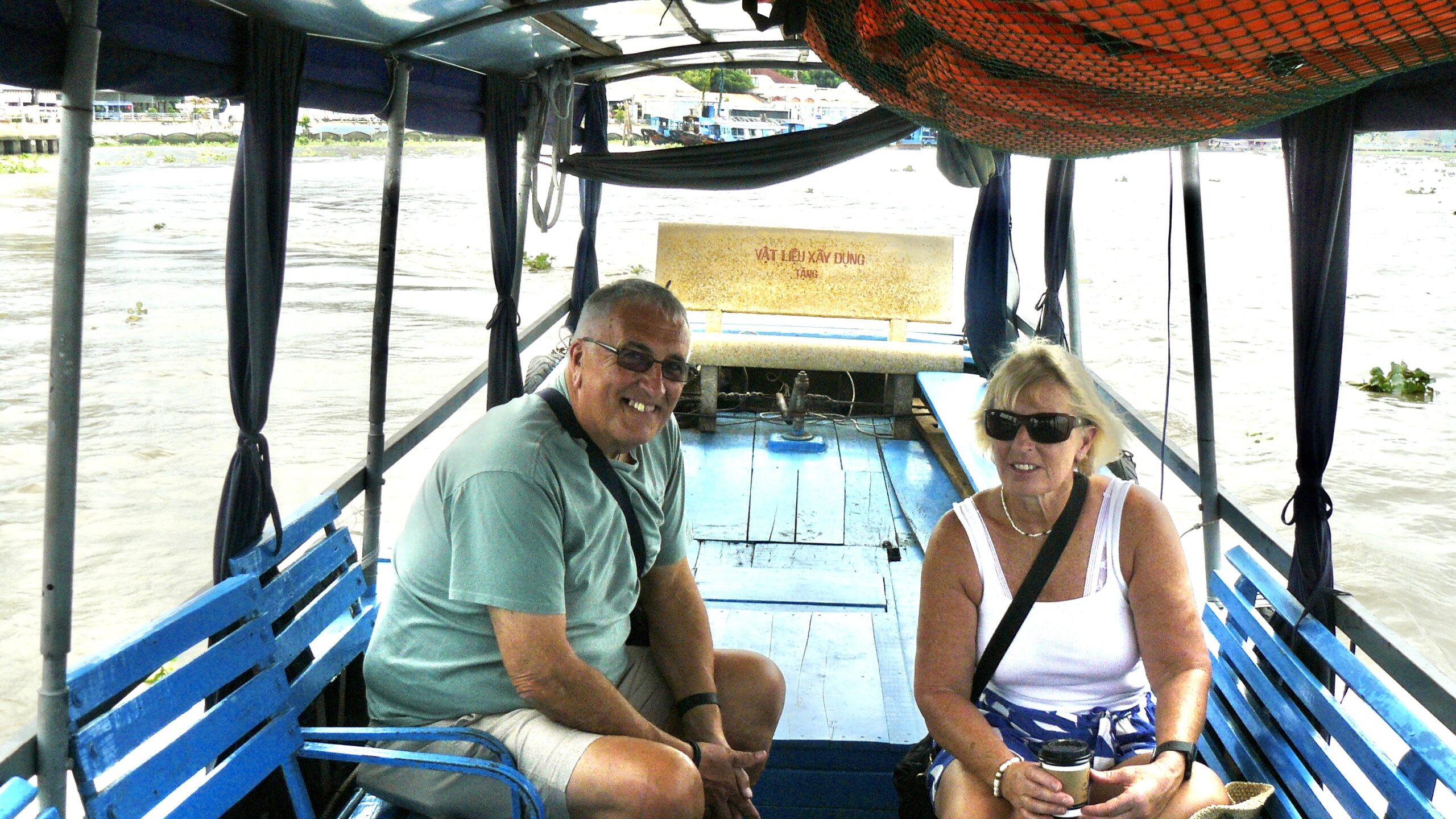
The Mekong Delta is a vast and fertile region where the Mekong River fans out into a network of rivers, swamps, and islands before emptying into the South China Sea. Our trip today was in the company of Jason Nguyen, our friendly, knowledgeable and efficient guide. He picked us up at 8am from the hotel and soon we were winding our way out of the city’s busy, crowded streets and into the surrounding countryside.

Jason explained that the Delta is a vital agricultural hub, producing more than half of the country’s rice, along with abundant fruits, vegetables, and seafood. As we got closer to the Delta area we saw hundreds of hectares of brilliant green paddy fields of rice growing.
But life in the Mekong Delta revolves around the water, with floating markets, stilt houses, and boat travel forming an essential part of daily life. Soon, the three of us were aboard a long, thin boat setting off across the river to our first stop, Unicorn Island. Known locally as Cồn Thới Sơn, is one of the four famous islets in the Tien River. The river is dotted with floating vegetation which Jason called ‘water lily’. It can be a problem as the thick plant material can clog up propellors and waterways.


Our first stop was the honey bee farm on Unicorn Island, The honey bees here are tiny compared to the ones we have in Australia and very unaggressive. The honey the produce is much runnier than Australian or New Zealand honey and they make a nice hot tea drink out of it. They also make a kind of biscuit with it. The taste is different too – Annette says it had almost got a lemony taste to it and certainly wasn’t thick.

They use traditional methods and the hives are there for you to see the bees at work.
Just on from there, a new culinary experience, with pop corn made from rice. It’s quite a technique involving a very hot wok, sand and oil. Rice, which still has the husk on it, is placed in the wok with the sand and the oil, and the next thing, there are dozens of little ‘pop’ sounds and puffy white rice appears. This is filtered to get rid of the sand (which has to be there to prevent the rice burning) and then filtered again to get rid of the husks. The rice at this stage is a bit tasteless but it’s then seasoned and sold with everything from chocolate to seaweed.
Travel in the area is by boat along narrow canals shaded by water coconut trees. The trick getting on to these narrow boats is to put your foot in the centre of the boat, not the edge. Our boat was propelled by a tiny girl at the front. She must have arms to pure steel!

Next we saw how Coconut candy is made. The coconut is opened and the white ‘meat’ shredded. This is then pressed to produce coconut milk, which is then stirred and heated until it forms a kind of sweet fudge. Nothing of the coconut goes to waste – the leaves, the trunk – even the hairy exterior of the coconut can be used to make rope.
Time for lunch – but first we have to have a go at cooking a traditional local delicacy, Bánh Khọt (Miniature Crispy Shrimp Rice Cake). It’s a rice flour batter cooked in very hot oil and then a shrimp added on top. They’re delicious. And we didn’t make too bad a job of it.

And then for lunch, a traditional Vietnamese fish meal with a sticky rice ball and loads of good stuff:

Our time on the islands was almost over. We’d been given a close look at traditional Mekong Delta lifestyles, with quiet villages, bicycle paths, and stilted houses along the waterways – and a relaxed lifestyle. So THIS is how you chill:

Our final stop was at the Vinh Trang Pagoda which serves as a vital center for Buddhist practice and Vietnamese heritage. It has provided refuge to patriots and continues to be a place of worship and cultural preservation.

Established in 1849, the site spans approximately 20,000 m² and is recognised as a national historical and cultural relic. It’s a fascinating mix of European influences – slender round columns, curved arches, and Romanesque patterns reflect European architectural styles – and Asian styles, with Chinese, Khmer, and Vietnamese architectural elements, including intricate carvings and decorative motifs.
Jason pointed out the characters written in the arched entrance to the temple. They looked very similar to Chinese pictograms. In fact, the ancient Vietnamese writing that resembles Chinese is called Chữ Nôm (𡨸喃). This script was used for centuries in Vietnam to write the Vietnamese language using modified and borrowed Chinese characters. Chữ Nôm was replaced by the Latin-based quốc ngữ script in the 20th century, which was easier to learn and more accessible. Quốc ngữ is now the official writing system of Vietnam. Today, Chữ Nôm is mostly studied by historians, linguists, and scholars, but it remains a symbol of Vietnam’s rich literary and cultural heritage.

Vinh Trang Pagoda houses over 60 Buddha statues crafted from materials such as wood, bronze, and terracotta, including an enormous reclining Buddha and a huge seated one.
And then our trip was over. Jason took us back to the hotel in the city centre, and we were sad to say goodbye. It was a fantastic way to spend the day, finding out about the traditional, vibrant way of life in the Mekong Delta.

