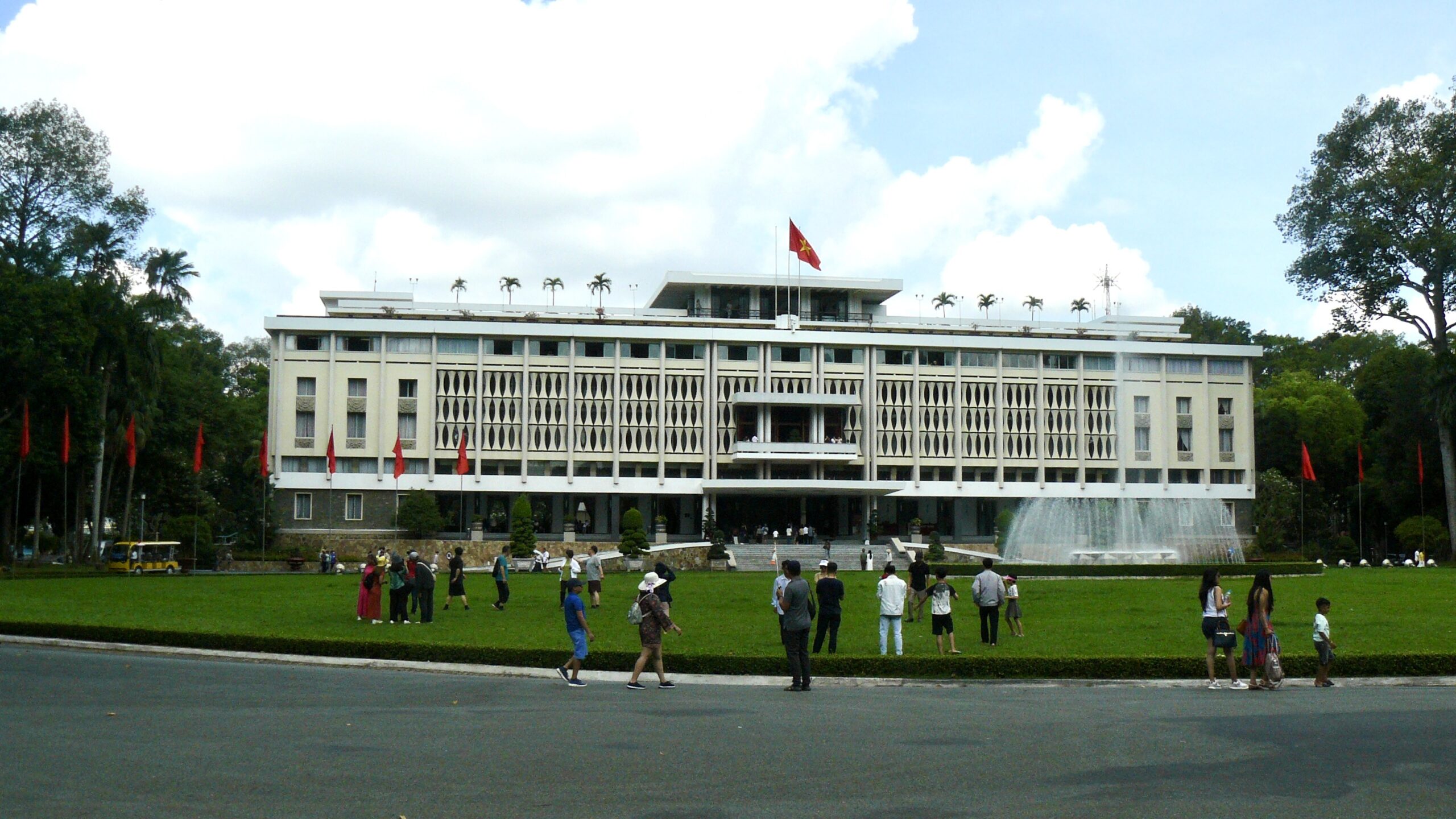
It’s our last day in Ho Chi Minh City, but we don’t fly out until the afternoon, and so we figured we had time to visit the Independence Palace.
The Independence Palace, also known as the Reunification Palace, is a historic landmark that holds deep significance in Vietnam’s modern history. Originally built in the 1860s as the residence of the French Governor-General, the current structure was completed in 1966 and served as the presidential palace for South Vietnam during the Vietnam War. It’s very 60s architecture but surrounded by a beautiful park.

The palace became globally symbolic on April 30, 1975, when a North Vietnamese tank famously crashed through its gates, marking the end of the Vietnam War and the reunification of the country. Today, the Independence Palace is preserved as a museum. There have been lots of reminders around the city as we’ve walked around as there were big celebrations of the 50th Anniversary only a month ago.

Inside the Palace, you can explore its original war rooms, underground bunkers, communication centers, and lavish reception halls, all left as they were decades ago. The former president of South Vietnam certainly knew how to live – the reception rooms are sumptuously furnished and quite, well, palatial. There was even a private cinema with a full scale projection room.
Not that it did any of them any good. The first president of the Republic of Vietnam was Ngô Đình Diệm from 1955 to 1963 when he was assassinated in a military coup led by Dương Văn Minh who served briefly as head of state after the coup before falling out with other military leaders. But he was back in 1975 as the North Vietnamese forces advanced rapidly toward Saigon in April. President Trần Văn Hương handed power to Dương Văn Minh in a last-ditch attempt to negotiate peace which failed, On April 30, 1975, realizing the futility of resistance, Minh went on national radio and announced the unconditional surrender of South Vietnam.

The rooms have been left pretty much as they were during the war, giving a glimpse into a turbulent time. The maps on the wall show the inexorable advance of the North Vietnamese troops. Underneath the palace is a huge bunker, where the President and his family and the military leaders would go when under attack. Much of the equipment – such as the radio communications gear – is still there.

So I’m not one to go all symbolic on you, but up on the roof of the palace is a military helicopter from the time… and sitting on it while we were there was a white dove, the symbol of peace.

And so our stay in Ho Chi Minh City was over. We said goodbye to the lovely Minnie who had looked after us at the hotel (rave review on Google) and headed to the airport to catch our flight to Siem Reap… where we were greeted by a very loud band…

In torrential rain we headed from the airport into Siem Reap… but that’s tomorrow’s story.

